
If your creator business has outgrown a basic list of links, you are probably already looking for a Linktree alternative.
That usually happens when one or more of these problems show up:
- your bio page looks generic
- your best content gets buried too quickly
- you want stronger analytics than simple click counts
- you need better control over branding and layout
- you want your bio page to support monetization, email capture, or creator growth
In 2026, the category has moved well beyond “one page with a few buttons.” The strongest tools now help creators manage three things together:
- traffic routing
- audience conversion
- content freshness
That is the lens this comparison uses. Instead of asking “which tool gives me more links,” the better question is “which tool helps me turn profile traffic into growth?”
Why Creators Look for Linktree Alternatives
Linktree is still the name most people recognize, but recognition is not the same as fit.
Creators usually start looking elsewhere when they want:
- more design control
- easier monetization
- better analytics
- a more content-rich layout
- mobile-first editing
- a page that feels like part of a wider creator workflow
That wider workflow matters more now because a creator page is rarely just a profile add-on. It often sits between:
- Instagram or TikTok discovery
- newsletter or community growth
- product, merch, or booking conversion
- content publishing and post scheduling
If your page needs to do all of that, a “link in bio tool” starts to look more like a lightweight creator growth platform.
If you mainly care about Instagram profile traffic, also review our Instagram bio link guide. If your audience is video-led, your setup may look very different from a coach, artist, or ecommerce creator.
How to Choose the Right Linktree Alternative
Before you compare tools, define what the page actually needs to do.
Ask these questions first:
Do you need a simple multi-link page or a growth hub?
Some creators only need a clean page with featured links. Others need content blocks, analytics, monetization, email capture, and automated content updates.
Is your audience mobile-first?
If most of your work happens from a phone, editing experience matters a lot. A desktop-first tool can become friction fast if you post and update on the go.
Do you need creator monetization features?
If you sell digital products, collect leads, promote affiliates, or book services, the right choice may be very different from someone who only wants to route viewers to recent content.
Do you want the page to stay fresh automatically?
This is one of the biggest category shifts. Tools that can surface recent content, sync social activity, or support ongoing creator workflows are more useful than static pages that go stale.
Do you care about analytics beyond raw clicks?
If you want to understand which content themes, launches, or offers actually convert, look for tools that treat analytics as part of growth rather than an afterthought.
How We Evaluated These Linktree Alternatives
This comparison is built around creator workflows, not just feature lists.
Each option was evaluated on five practical questions:
- Does it help route profile traffic to the right destination?
- Is it easy to keep current as content, offers, or campaigns change?
- Does it support stronger branding than a plain link list?
- Can it help with conversion, monetization, or audience capture?
- Does it fit inside a wider creator growth system if you need one?
That framework matters because “best Linktree alternative” means different things depending on whether you are:
- a creator trying to route traffic to current content
- a coach or consultant converting profile views into leads
- an artist or musician promoting releases and merch
- an ecommerce creator using profile traffic to drive product discovery
Best Linktree Alternatives for 2026
These are the five alternatives most worth evaluating if you want more than a basic Linktree replacement.
1. Lnk.Bio
Lnk.Bio is a practical choice for creators who want a familiar link-in-bio setup with a low barrier to entry.
Best for: budget-conscious creators who want a straightforward replacement for Linktree without a steep learning curve.
Why creators choose it:
- simple multi-link layout
- fast setup
- enough customization for many solo creators
- relatively accessible upgrade path
Where it fits best:
Lnk.Bio works well if your main goal is “I want a cleaner or more flexible version of Linktree” rather than “I need an all-in-one growth stack.”
Where it can feel limited:
- less differentiated for creators who want a more visual or branded experience
- not the strongest option if your bio page needs to become a richer content destination
2. Campsite
Campsite is a strong middle-ground option for creators and small brands that want a polished page with more layout flexibility and better presentation.
Best for: creators who care about visual presentation, cleaner organization, and a more polished public-facing page.
Why creators choose it:
- more design flexibility than the simplest bio tools
- a good balance between ease of use and customization
- useful for creators who want a more brand-forward page
Where it fits best:
Campsite makes sense if you want something more expressive than a plain link list but do not need a heavy all-in-one creator platform.
Where it can feel limited:
- still more of a page builder than a broader creator operating system
- growth workflows may depend on additional tools elsewhere in your stack
3. Milkshake
Milkshake takes a very different angle: it is designed for creators who want a mobile-first, more visual “mini-site” experience.
Best for: creators who manage most things from their phone and want a page that feels more expressive than a typical link list.
Why creators choose it:
- mobile-friendly workflow
- stronger visual personality
- good fit for creators whose audience expects a more lifestyle-driven or aesthetic presentation
Where it fits best:
Milkshake works especially well for creators who want a bio page to feel like an extension of their content style rather than a neutral utility page.
Where it can feel limited:
- less natural fit for creators who want deeper operational workflows
- not the obvious first choice for teams, analytics-heavy users, or broader creator-business systems
4. Beacons
Beacons is one of the clearest examples of the category moving from “link in bio” to “creator platform.”
Best for: creators who want monetization, media-kit style functionality, and a wider operating layer around their audience.
Why creators choose it:
- broader creator-business feature set
- monetization orientation
- good fit for creators who want one hub for more than link routing
Where it fits best:
Beacons is a strong fit if your page needs to support sponsorships, digital offers, audience capture, and creator business operations in one place.
Where it can feel limited:
- more feature-heavy than some creators need
- can feel more complex if all you want is a clean, lightweight page
5. Slashlink
Slashlink is best understood not as a “cheaper Linktree,” but as a creator-first bio page that is moving toward a broader growth workflow.
Best for: creators who want the bio page to sit inside a larger system of content creation, publishing support, and profile performance.
Why creators choose it:
- free creator bio page with templates and analytics
- unlimited links and stronger presentation than a plain list
- auto-updating content support for creators who do not want stale profile pages
- optional AI tools that connect content creation with the rest of the creator workflow
Where it fits best:
Slashlink is strongest for creators who want their bio page to work with:
- content publishing
- audience growth
- sponsor proof or click reporting
- AI-assisted content workflows
That makes it a better fit for creators who think in terms of systems, not just profile setup.
Where it can feel limited:
- newer category positioning means some users will still compare it to simpler tools first
- creators looking only for a basic multi-link list may not use its wider growth angle fully
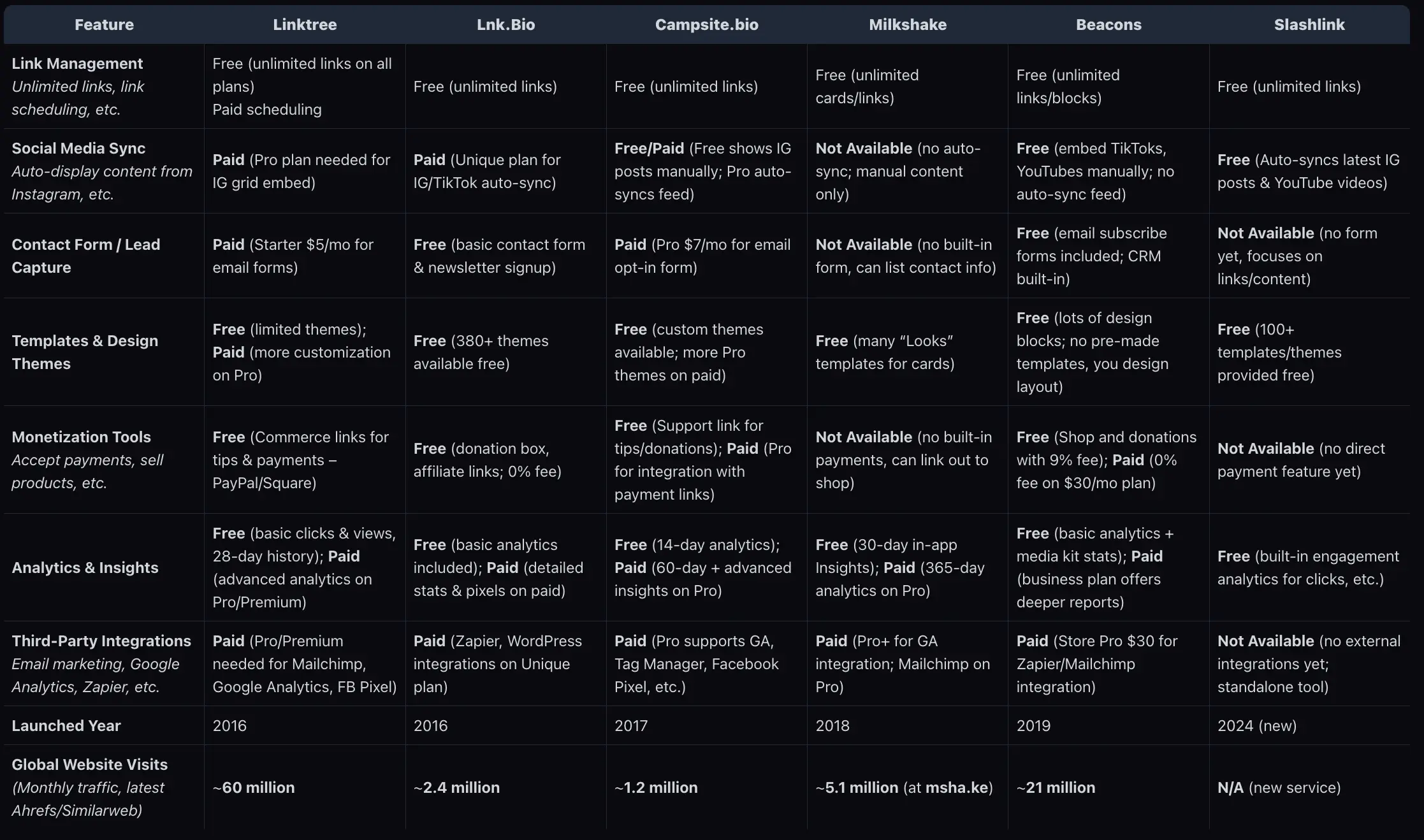
Linktree vs Alternatives Comparison Framework
Instead of choosing purely on brand familiarity, compare tools across the dimensions that matter most for creator growth:
| Priority | What to evaluate |
|---|---|
| Design control | How far can you move beyond a generic link list? |
| Monetization | Can the page support products, services, affiliates, or lead capture? |
| Content freshness | Does the page stay current, or does it need constant manual updates? |
| Analytics | Can you learn which links, campaigns, or content themes perform best? |
| Workflow fit | Does the tool connect naturally with the rest of your creator stack? |
| Mobile editing | Can you keep the page updated quickly from your phone? |
Here is the faster creator-type view:
| Creator need | Best-fit direction |
|---|---|
| Low-friction replacement for Linktree | Lnk.Bio |
| More polished public-facing page | Campsite |
| Mobile-first visual mini-site | Milkshake |
| Monetization and creator-business hub | Beacons |
| Bio page plus creator growth workflow | Slashlink |
This is also why “best Linktree alternative” is not one universal answer.
The best choice for a musician, coach, educator, or ecommerce creator will not be the same because the page is doing a different job in each business model.
Which Linktree Alternative Is Best for You
Here is the simplest short-list:
- Choose Lnk.Bio if you want a lightweight, affordable replacement with minimal friction.
- Choose Campsite if you want a more polished, brand-forward public page.
- Choose Milkshake if you want mobile-first editing and a more visual mini-site experience.
- Choose Beacons if monetization and creator-business features matter most.
- Choose Slashlink if you want the page to be part of a broader creator growth workflow with analytics, freshness, and AI support.
If you already know your audience type, the best next step is not just picking a tool. It is choosing a structure that matches your creator model. For example:
- musicians and artists can review music creator bio page ideas
- video-first creators should pair the bio page with better content workflows like the Instagram caption generator
- creators focused on profile performance should treat the page as a conversion asset, not just a list of destinations
If you are a creator selling offers or products
Prioritize:
- email capture
- product or booking flow support
- analytics that go beyond raw click counts
- flexible page structure for launches and campaigns
If you are a creator focused on content growth
Prioritize:
- content freshness
- easier routing from current posts to current offers
- mobile editing speed
- stronger connection between publishing and profile traffic
If you are still validating your niche
Prioritize:
- low setup friction
- enough analytics to spot what gets clicks
- a page you can update frequently without redesigning it every week
Best Linktree Alternative: Final Recommendation
The best Linktree alternatives in 2026 are no longer just competing on “how many links can I add?” They are competing on how well they help creators grow.
That means the strongest choice is usually the one that best supports your next stage:
- better routing
- better branding
- better analytics
- better monetization
- better content workflow
If your page is becoming part of a bigger creator growth system, prioritize tools that help you publish, convert, and learn, not just organize links.
How to Switch From Linktree to a Better Linktree Alternative
If you already have your audience trained to click one profile URL, the goal is not to switch recklessly. It is to migrate without introducing confusion.
Use this checklist:
- Keep your public URL structure stable wherever possible.
- Rebuild your top-priority destinations first, not every legacy link at once.
- Put your current CTA above the fold before updating your social bios.
- Test the page on mobile before changing the live profile link.
- Update Instagram, TikTok, YouTube, and any pinned references together.
- Measure click behavior for the first two to four weeks after the move.
The biggest mistake is changing tools without improving page strategy. If the new page still has weak prioritization, stale content, or unclear CTAs, the migration will not help much.
Frequently Asked Questions
What is the best Linktree alternative for creators?+
The best Linktree alternative depends on what your bio page needs to do. Some creators only need a clean multi-link page, while others need stronger branding, monetization, analytics, or a wider creator growth workflow. The right choice depends more on your creator model than on brand popularity alone.
Are there free Linktree alternatives?+
Yes. Several Linktree alternatives offer free entry points. The bigger question is not whether a tool is free, but whether the free version supports the design, analytics, content freshness, and conversion goals you care about.
Should I change my existing URL if I move away from Linktree?+
Not necessarily. If you already have audience habits built around one profile link, focus on migrating carefully and keeping the destination clear. Consistency matters, especially if your link is already used across social platforms, bios, or older content.
What should I look for in a Linktree alternative in 2026?+
Look for the features that match how creators grow now: stronger branding, better analytics, a page that stays fresh, mobile-friendly editing, and support for monetization or broader content workflows. A good alternative should help you turn profile traffic into measurable action.